CyberFreezeDev Loading
  1. Home
  2. Services
  3. Custom AI systems

Custom AI systems built on your own data and business rules

When off-the-shelf AI does not fit, we design, test and host the system itself.

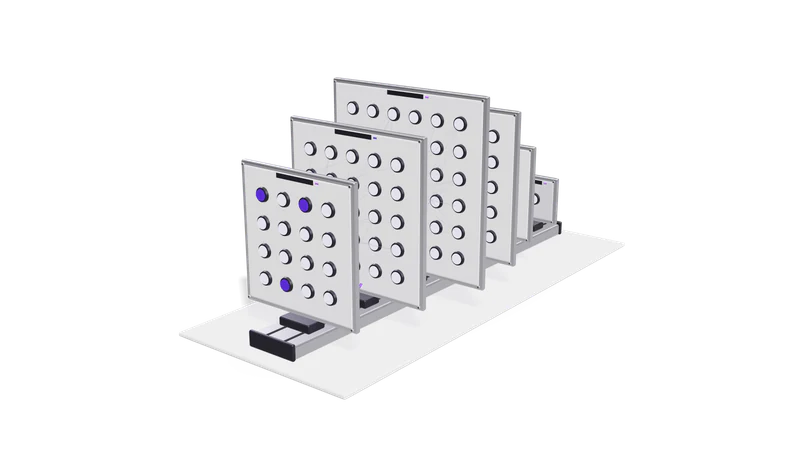
3D render of matte panels of neural network nodes, with activations lighting up layer by layer

At a glance

Custom AI systems
Hosted models
Claude, GPT, Gemini
Open-weight models
Llama, Qwen, Mistral and others, on your hardware
Patterns
Retrieval (RAG), classification, extraction, agents with tools
Data sources
Documents, databases, CRM, Google Workspace, internal APIs
Quality checks
Test set of real examples, scored on every change
Interfaces
Web app, WhatsApp, Slack, email, or an API for your software
Hosting
Your cloud, our managed server, or on-premise

When custom AI development makes sense

Most businesses should start with existing tools. Some reach the limit quickly.

Custom AI is for when the model must use your data, follow your rules, feed your systems and be measured.

Read more about When custom AI development makes sense

A general chat assistant knows nothing about your price list, your SOPs, your past cases or your customers. You can paste things in, but that does not scale to a team, and it means sensitive data is going wherever the tool sends it.

Custom AI development is for the point where you need the model to work on your own data, follow your own rules, plug into your own systems and be measured. Typical triggers we hear: answers must cite the internal document they came from; the data cannot leave the company; the output has to land in the ERP, not in a chat window; or the team needs the same answer every time for the same input.

If you mainly need a question-answering assistant over documents, our RAG chatbots and knowledge assistants page goes deeper on that one pattern. If you need the model on your own servers, see private AI deployment.

What we build

Knowledge assistants

Answers from your SOPs and contracts, quoting the passage, within existing permissions.

Read more about Knowledge assistants

An assistant that answers from your SOPs, contracts, product manuals or case files, quotes the passage it used, and says it does not know when the answer is not there. Access follows your existing permissions, so a sales rep cannot pull HR documents.
Classifiers and extractors

Tickets, emails and claims sorted into your categories, with error rates per category.

Read more about Classifiers and extractors

Models that sort tickets, emails, claims or leads into your categories, or pull structured fields out of free text. Built with a test set so you can see the error rate per category, not a single headline score.

Agents that use your tools

A model acting through defined tools, with every action logged and irreversible ones held.

Read more about Agents that use your tools

A model that can look up an order, create a task, draft a quote or update a record through defined tools, with every action logged and anything irreversible held for a person to approve. Our own products work this way: the AI assistant in Desk can be given work, and the agent in Fint proposes records that a person confirms.

Search across messy data

Find past cases, quotes and decisions in email and PDFs by describing them.

Read more about Search across messy data

Semantic search over years of email, chat exports, PDFs and spreadsheets, so staff can find the earlier case, quote or decision by describing it instead of guessing the file name.

Generation inside your workflow

Proposals, reports and replies drafted from your templates, edited by a person before sending.

Read more about Generation inside your workflow

Drafting proposals, reports, product descriptions or replies from your own templates and data, inside the tool your team already uses, with a person editing before anything goes out.

How a project runs

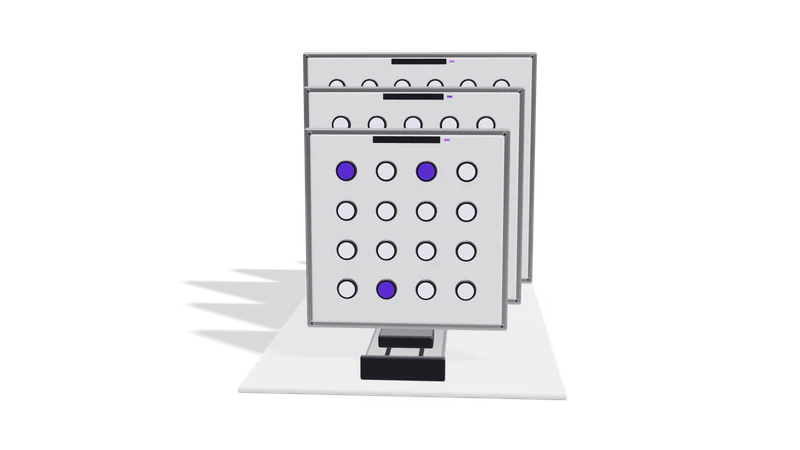
Fig. 01 Face on: nodes lighting up in the first layer, later layers behind
  1. 01 Define the job and collect examples

    Real inputs and your best person's answers become the measuring stick.

    Read more about Define the job and collect examples

    We write down exactly what the system should do and collect real inputs with the answers your best person would give. That set becomes the measuring stick for every later decision.

  2. 02 Prototype against the examples

    Two or three approaches scored on your examples for quality, speed and running cost.

    Read more about Prototype against the examples

    We try two or three approaches, usually a hosted model and an open-weight one, and score them on your examples for quality, speed and running cost. You see the scores and the failures, not a demo picked to impress.

  3. 03 Build the system around the model

    Connectors, retrieval, permissions, interface, logging and a review step, all under version control.

    Read more about Build the system around the model

    Data connectors, retrieval, permissions, the interface your team will use, logging and the review step for uncertain outputs. Prompts and configuration are kept under version control like any other code.

  4. 04 Pilot with real users

    A small group uses it live, and their corrections join the test set.

    Read more about Pilot with real users

    A small group uses it on live work. Their corrections are added to the test set so the same mistake is caught automatically next time.

  5. 05 Launch and monitor

    Usage and cost tracking, quality spot checks and a plan for retired models.

    Read more about Launch and monitor

    Production deployment with usage and cost tracking, quality spot checks, and a plan for when a model is updated or retired by its provider.

Where it fits, and where it does not

Good fit

Frequent tasks with clear examples of a good answer and a check before harm.

Read more about Good fit

A task that is done often, where you can show examples of a good answer, and where a wrong answer is caught by a person or a check before it causes harm.

Poor fit

No agreed right answer, no review possible, or a simple rule already works.

Read more about Poor fit

Tasks where no one can say what a correct answer looks like, or where a single wrong answer is unacceptable and cannot be reviewed. Also anything a simple rule or a database query already does well; we will tell you when AI is the expensive way to do it.

Private and on-premise

Open-weight models on a GPU machine you own, tested first in our lab.

Read more about Private and on-premise

Open-weight models can run on a GPU workstation or server you own. Our lab tests these models on our own hardware, including an 8 GB laptop GPU, before recommending them. For larger setups see GPU servers and AI hardware.

Automation first

Mostly moving data with one AI step? A workflow build is faster and cheaper.

Read more about Automation first

If the work is mostly moving data between systems with one AI step in the middle, a workflow automation build is faster and cheaper than a custom system.

Questions

Which model do you use?

The one that scores best on your examples at a cost you accept. We regularly compare Claude, GPT and Gemini with open-weight models such as Llama, Qwen and Mistral. Privacy rules can decide the question before quality does.

Will our data be used to train someone else's model?

We use API terms and settings that exclude your data from provider training where the provider offers that, and we can run open-weight models on your own hardware so data never leaves. We show you the settings in writing.

Do you fine-tune models?

Sometimes, when retrieval and good prompts are not enough, for example to fix a consistent output format or a specialised vocabulary. Fine-tuning needs a good-sized set of clean examples and adds upkeep every time the base model changes, so we try the simpler options first.

How do we know it is working after launch?

The test set is re-run whenever a prompt, model or data source changes, and a sample of live outputs is reviewed on a schedule. Cost and usage are tracked per feature so a runaway bill is caught early.

Who owns the code?

Ownership is written into the agreement before work starts. Whatever is agreed, the prompts, configuration and test set are documented and handed over with the system, so you are never locked into us to keep it running.

Last updated