CyberFreezeDev Loading
  1. Home
  2. Services
  3. Edge AI and IoT

Edge AI development: models that run on the device, next to the camera or sensor

Small on-site computers that watch, measure and decide; only results reach your dashboard.

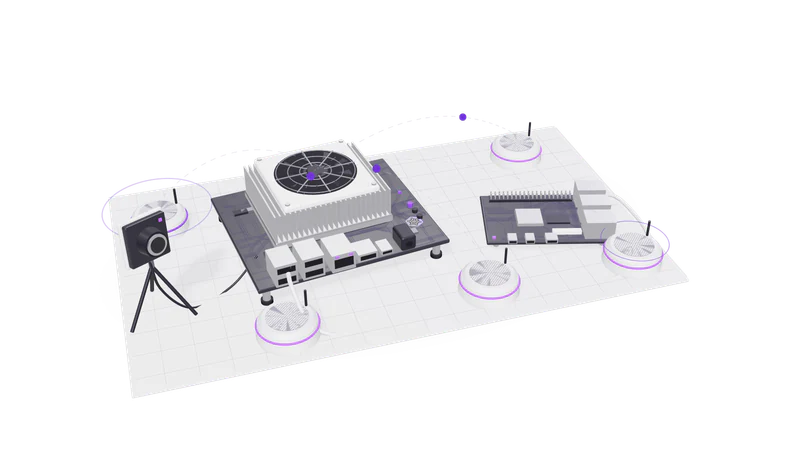
3D render of an AI developer kit, a single board computer, a camera module and IoT sensor pucks

At a glance

Edge AI and IoT development
Compute
NVIDIA Jetson Orin, Raspberry Pi 5 with AI HAT+, Google Coral Edge TPU
Inputs
USB and CSI cameras, RTSP feeds from existing CCTV, temperature, humidity, current, vibration and level sensors
Model formats
TensorRT, ONNX, LiteRT (TensorFlow Lite), Hailo HEF
Protocols
MQTT, HTTP, Modbus RTU and TCP, GPIO, I2C, SPI
Connectivity
Ethernet, Wi-Fi, 4G modem; store and forward when the link drops
Outputs
Events and counts to a dashboard, WhatsApp or email alerts, rows into your database

What edge AI is, and why run it on the device

The model runs on a small computer beside the camera or sensor, which saves bandwidth, keeps footage on site and works when the internet drops.

Read more about What edge AI is, and why run it on the device

Edge AI means the model runs on a small computer at the place where the data is produced, instead of sending everything to a server or a cloud API. A camera on a packing line does not stream video to the cloud: a board beside it detects each carton, counts it and sends one line of data per minute.

That design has practical advantages for factories, warehouses, clinics and shops:

  • Bandwidth. One 1080p camera stream is several megabits per second, all day. A count or an alert is a few bytes.
  • Privacy. Footage of people never leaves the site. Only counts and events do, which keeps the data map simple under the DPDP Act 2023 or UK GDPR.
  • Speed. Rejecting a faulty part or stopping a conveyor cannot wait for a round trip to a data centre.
  • Resilience. The device keeps working when the internet drops and sends its backlog when it returns.

Edge AI and IoT is one of the tracks in CyberFreeze Labs, where we test boards, cameras and sensors before they go into a client design. See the edge AI and IoT lab track.

The boards we build on

Each one suits a different size of model and budget. Figures are the vendors' published specifications.

BoardAI computeMemoryPowerGood for
NVIDIA Jetson Orin Nano Super67 TOPS (INT8)8 GB LPDDR5, 102 GB/s7 to 25 WSeveral camera streams, larger detection and segmentation models, small language and vision models
Raspberry Pi 5 with AI HAT+13 TOPS (Hailo-8L) or 26 TOPS (Hailo-8)Pi 5 system memoryLow, Pi 5 power supplyOne or two cameras, object detection and pose models, low unit cost
Google Coral Edge TPU4 TOPSUses the host's memoryAbout 2 TOPS per wattAdding fast classification or detection to an existing Linux box over USB or M.2
Microcontrollers (ESP32 class)None neededKilobytesBattery friendlyReading sensors and sending readings over Wi-Fi or a gateway, where the decision is a threshold, not a model

Raspberry Pi has also released an AI HAT+ 2 built on the Hailo-10H; we evaluate new boards in the lab before recommending them. Models must be compiled for the specific accelerator, so the board choice is made early.

Typical problems we build for

Counting and inspection on a line

Units counted and missing caps or dented cartons logged with a photo.

Read more about Counting and inspection on a line

Count units, check a label is present, spot a missing cap or a dented carton, and log each event with a photo for review.
Cold chain and environment monitoring

Cold room and fridge sensors alert on WhatsApp and keep a log for auditors.

Read more about Cold chain and environment monitoring

Temperature and humidity sensors in cold rooms, pharmacy fridges or server rooms, with alerts on WhatsApp when a reading stays out of range, and a daily log you can hand to an auditor.

Machine health

Current and vibration sensors learn a motor's normal pattern and flag drift early.

Read more about Machine health

Current clamps and vibration sensors on motors and pumps. A small model learns the normal pattern and flags drift before a breakdown.

Reading old meters and gauges

A camera reads analogue gauges with no data port and logs the values.

Read more about Reading old meters and gauges

A camera pointed at an analogue gauge or a display that has no data port, read by a model every few minutes and written to a spreadsheet or database.

Occupancy and footfall

People counts per zone, with no images stored.

Read more about Occupancy and footfall

People counts per zone for retail and facilities teams, with no images stored, only the numbers.

How an edge AI project runs

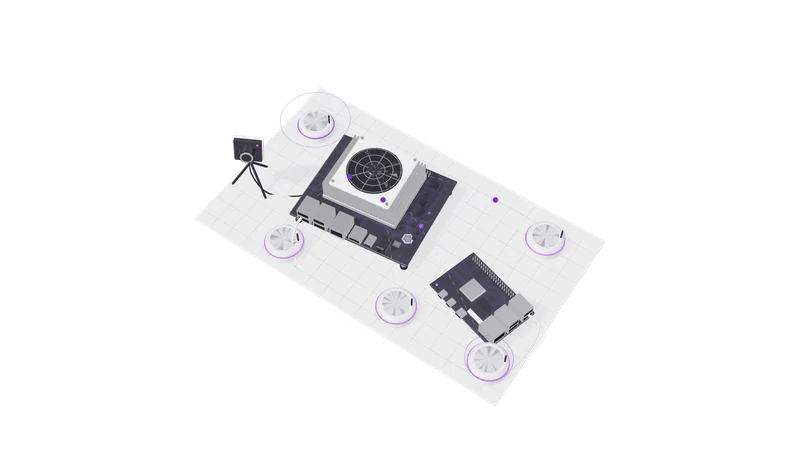
Fig. 01 Overhead: dev kit, board, camera module and sensor pucks
  1. 01 Site and data survey

    Lighting, distance, mounting, power and network checked, since placement decides most outcomes.

    Read more about Site and data survey

    Photos or a video call of the spot: lighting, distance, mounting, power and network. Most edge projects succeed or fail on camera placement and light, not on the model.

  2. 02 Sample collection

    Days of real footage or readings, including glare, night shifts and dirty lenses.

    Read more about Sample collection

    We record real footage or sensor readings from your site for a few days, including the bad cases: glare, night shift, dirty lenses, unusual products.

  3. 03 Model training or selection

    An existing detector where one fits, otherwise a small model trained on your samples.

    Read more about Model training or selection

    An existing detection model where one fits; otherwise we label your samples and train a small model. We report accuracy on footage the model has not seen.

  4. 04 Compile for the board

    Model quantized for TensorRT, Hailo or the Edge TPU and measured on the device.

    Read more about Compile for the board

    Convert and quantize the model for TensorRT, Hailo or the Edge TPU, then measure frames per second and power on the actual device.

  5. 05 Bench prototype, then site pilot

    One unit in our lab, then one on site for two to four weeks.

    Read more about Bench prototype, then site pilot

    One unit running in our lab against recorded footage, then one unit on site for two to four weeks with results checked by your team.

  6. 06 Rollout and remote care

    Enclosures, remote updates, a silent-device alert and a results dashboard.

    Read more about Rollout and remote care

    Enclosures, mounting, remote updates, a health check that alerts if a device goes silent, and a dashboard for the results.

Where the results go

Results go to MQTT, a dashboard, a WhatsApp alert or an n8n workflow. We build sensing and vision, not robots or motion control.

Read more about Where the results go

An edge device is only useful if someone acts on what it sees. We connect results to the tools you already use: an MQTT broker or a small database on site, a dashboard, a WhatsApp alert to the shift supervisor, or an n8n workflow that raises a ticket and emails a report. When the edge device needs a bigger model than it can hold, it sends the hard cases to a private AI server in your building rather than to a public API.

We do not build robots or motion control. Our edge work is sensing, vision and decisions that a person or an existing control system then acts on.

Questions

Can you use our existing CCTV cameras?

Often, yes. Most IP cameras offer an RTSP stream that a Jetson or Raspberry Pi can read. Whether the image is good enough depends on resolution, angle and lighting, so we check sample footage first.

Which board should we use, Jetson or Raspberry Pi?

Raspberry Pi with an AI HAT+ is cheaper per unit and fine for one or two cameras running a detection model. Jetson Orin costs more but handles several streams, larger models and some small language and vision models. We pick after measuring your model on both when the choice is close.

What happens when the internet goes down?

The device keeps running its model and stores results locally. When the connection returns, it sends the backlog in order. Alerts that cannot wait can go over a 4G modem.

How do you update devices once they are installed?

Each device pulls signed updates for its model and software from a server you control, and reports its version and health. A device that stops reporting raises an alert.

Last updated