CyberFreezeDev Loading
  1. Home
  2. CyberFreeze Labs
  3. Edge AI and IoT

Edge AI and IoT: which decisions belong on the device

We test whether shrunk models still work on small devices next to the camera or sensor.

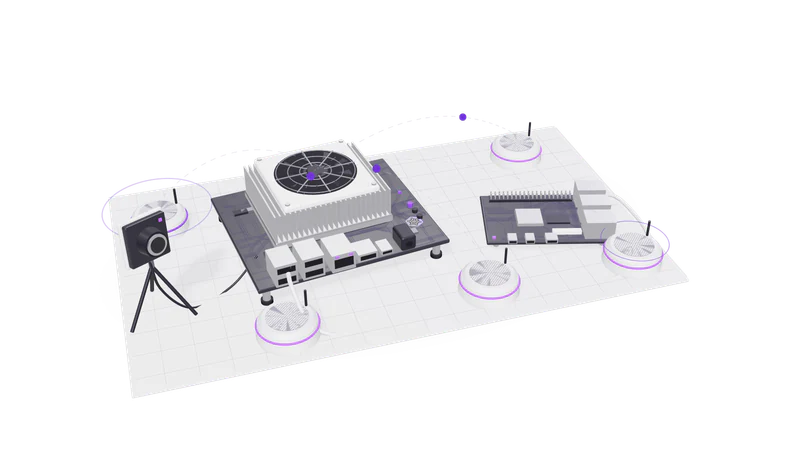
3D render of an AI developer kit, a single board computer, a camera module and IoT sensor pucks

Device, building or cloud

We measure on real Jetson, Raspberry Pi and Coral boards whether a job belongs on the device, a building server or the cloud.

Read more about Device, building or cloud

For a given job, such as counting people at a shop entrance, spotting a defect on a production line, or flagging a motor that has started to vibrate differently, should the model run on the device, on a server in the building, or in the cloud?

The answer depends on five things: how fast a decision is needed, how much data the sensor produces, what power is available, whether the raw data may leave the site, and who will maintain the device after installation. This track measures those trade-offs on real boards rather than spec sheets. Edge hardware is where our team already does hands-on work, with NVIDIA Jetson, Raspberry Pi and Google Coral boards and with IoT devices and sensors.

Findings feed our edge AI and on-device AI and computer vision services. For choosing a board, see our Jetson vs Raspberry Pi comparison.

Why it matters on site

Bandwidth and data costs

A device that sends events instead of video needs almost no upload.

Read more about Bandwidth and data costs

A single camera streaming video all day is a lot of upload. A device that sends only events ("12 people entered between 10:00 and 10:15", "part 4471 rejected") needs almost none.
Decisions that cannot wait for the network

Reject gates and overheating alarms must answer on the spot, even offline.

Read more about Decisions that cannot wait for the network

A reject gate on a conveyor or an alarm on overheating equipment needs an answer on the spot, even when the internet is down.

Privacy by not collecting

Counting on the device without storing footage leaves far less personal data to protect.

Read more about Privacy by not collecting

If a camera counts people on the device and never stores or sends the footage, there is far less personal data to protect under the DPDP Act or GDPR.

It has to survive the site

Dust, heat, power cuts and no technician: devices must recover on their own.

Read more about It has to survive the site

Dust, heat, power cuts and nobody technical on site. A device that needs a person to restart it after every outage is not finished.

Edge test bench

Three classes of edge hardware, plus the lab GPU for training and converting models before they go to a device.

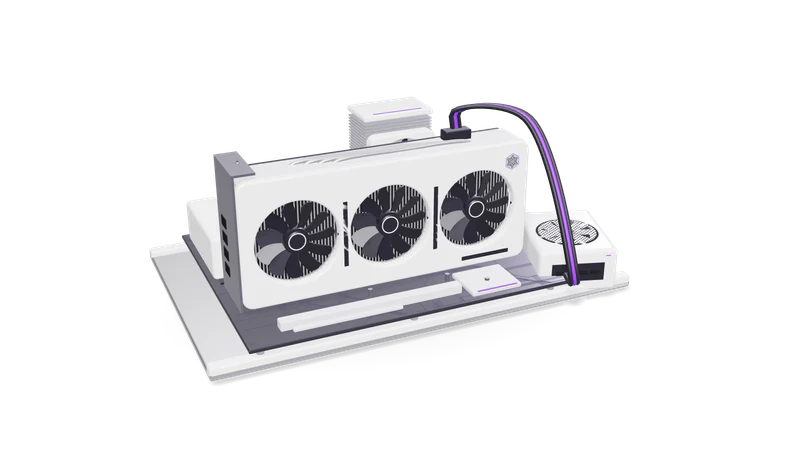
Fig. 01 GPU test bench used for sizing and benchmarks
Edge AI test benchLabs track 06
GPU edge boards
NVIDIA Jetson, with CUDA and TensorRT
Single-board computers
Raspberry Pi, CPU inference
Accelerator
Google Coral Edge TPU, 8-bit TensorFlow Lite models
Sensors
Cameras plus IoT sensors such as temperature and vibration
Training and export
NVIDIA GeForce RTX 3070 Ti Laptop GPU, 8 GB
Model exchange formats
ONNX, TensorRT engines, TensorFlow Lite
Stage
Boards on the bench; cross-board runs not yet published

Scoring on real boards

Each task gets the same model family exported to each board, run on the same recorded test data.

MetricHow we measure itWhat counts as success
Latency per inferenceTime from frame or reading in to decision out, on the device, median and slowest runsFaster than the process needs: a conveyor sets a much tighter limit than a footfall count
Sustained throughputFrames or readings per second over a long run inside its enclosure, not on an open benchHolds steady once the board is warm
Accuracy after shrinkingPrecision and recall on our labelled test set, before and after quantization and exportLoses little enough that the business result does not change
False alarmsAlerts raised on recordings where nothing was wrong, per day of dataLow enough that staff keep paying attention to alerts
Power drawMeasured at the supply during idle and full loadFits the power available on site, including battery or solar where relevant
RecoveryPull the power mid-run and watch what happens when it returnsBack to work with no human help and no lost configuration
Update pathDeploy a new model version remotely and roll it backWorks without a site visit

Test tasks: people counting from a fixed camera, visual defect detection on sample parts, and anomaly detection on recorded vibration and temperature data.

Vendor facts and working hypotheses

The first two points come from vendor documentation. The rest are hypotheses we are testing.

The Coral Edge TPU needs fully 8-bit models

Coral needs 8-bit quantized TensorFlow Lite models; unsupported operations fall back to the CPU.

Read more about The Coral Edge TPU needs fully 8-bit models

Per the Coral documentation, models must be TensorFlow Lite with 8-bit quantization and compiled with the Edge TPU compiler. Operations the TPU does not support fall back to the CPU, which can erase the speed gain. Model choice has to start from what the accelerator supports.

Jetson boards run TensorRT engines

TensorRT engines are compiled per board and software version, so they need rebuilding.

Read more about Jetson boards run TensorRT engines

On Jetson, models are usually converted with TensorRT, which compiles a network for the specific GPU. An engine built for one board and software version generally has to be rebuilt for another.

Hypothesis: send events, not data

Hypothesis: most value comes from sending counts and flags, not video or raw readings.

Read more about Hypothesis: send events, not data

We expect most of the business value of edge AI to come from what is not sent: counts, flags and summaries instead of video and raw readings.

Hypothesis: maintenance decides more projects than accuracy

Hypothesis: remote updates and power-cut recovery may matter more than a little extra accuracy.

Read more about Hypothesis: maintenance decides more projects than accuracy

A model that is slightly less accurate but updates remotely and recovers from power cuts will likely beat a better model that needs a technician. Our recovery and update tests exist to check this.

Run plan

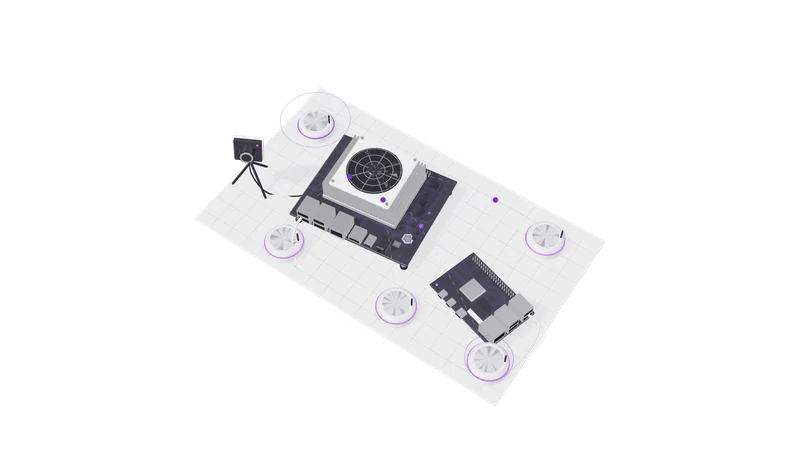
Fig. 02 Overhead: dev kit, board, camera module and sensor pucks
  1. 01 One detector, three boards

    One object detection model runs people counting on Jetson, Raspberry Pi and Coral.

    Read more about One detector, three boards

    Export one object detection model to Jetson, Raspberry Pi and Coral, and run the people counting task on all three with the same recordings.

  2. 02 Sensor anomaly baseline

    Simple thresholds compared with small learned models on vibration and temperature data.

    Read more about Sensor anomaly baseline

    Compare simple statistical thresholds with small learned models on vibration and temperature data, since the simple method is often enough.

  3. 03 Field conditions

    Runs repeated inside closed enclosures and through power interruptions.

    Read more about Field conditions

    Repeat the runs inside closed enclosures and with power interruptions, the way devices actually live on a factory floor or in a warehouse.

What we publish, and when

Notes will be published in the R&D / Labs notes section of our blog. Recordings used as test data are our own.

NotePublished whenWhat it contains
Method noteBefore any scoresThe three test tasks, the recorded datasets, how latency and power are measured, and the export path to each board
One detector, three boardsWhen the people counting task has run on Jetson, Raspberry Pi and CoralMedian and slowest latency, sustained throughput, precision and recall before and after export, and power at idle and load, with board, OS image and runtime versions
Sensor anomaly baselineAfter the vibration and temperature runsFalse alarms per day of data for statistical thresholds against small learned models
Field conditionsAfter runs in enclosures with power cutsThroughput once warm, recovery after power loss, and whether a remote model update and rollback worked

Questions

What is edge AI?

Running an AI model on a device near where the data is produced, such as a camera box or a sensor gateway, instead of sending the data to a server. The device sends results, not raw data.

Jetson, Raspberry Pi or Coral: which should I use?

Jetson suits heavier vision models and several camera streams; Coral suits small 8-bit models at low power; Raspberry Pi suits light models and sensor work where cost matters most. This track exists to make that choice with measurements instead of rules of thumb.

Do you build the hardware as well as the software?

We work hands-on with edge boards, IoT devices and sensors, and we build GPU servers for heavier workloads through GPU servers and AI hardware builds.

Which industries is this useful for?

Mainly manufacturing (defect checks, machine monitoring), logistics (counting and tracking at docks and warehouses) and retail (footfall).

Last updated