CyberFreezeDev Loading
  1. Home
  2. AI glossary
  3. Multi-agent system

What is a multi-agent system?

Several AI agents with narrow roles working on one goal and coordinating through messages.

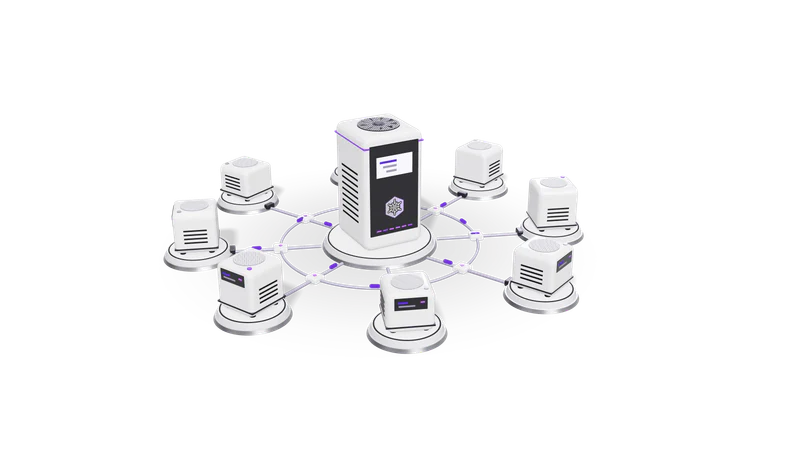
3D render of small AI agent units on plinths, cabled to a central orchestrator unit

The plain definition

Each agent has its own role, prompt, tools and permissions, coordinated by an orchestrator, a shared task board or messages.

Read more about The plain definition

A multi-agent system is two or more AI agents working on a shared goal. Each agent has a role, its own prompt, its own tools and its own permissions. They coordinate through an orchestrator that hands out tasks, through a shared task board, or by sending each other messages.

The idea is old in computer science; what is new is that each agent can now be a capable large language model. Frameworks such as Microsoft AutoGen, CrewAI and LangGraph are common starting points, and many teams write a thin coordination layer of their own.

How it works

  1. 01 Split the work

    Break the goal into roles such as intake, research, drafting and review.

    Read more about Split the work

    Break the goal into roles that need different tools or knowledge, for example intake, research, drafting and review.

  2. 02 Give each agent a narrow brief

    Short prompts, few tools, least access. A reviewer may read but not write.

    Read more about Give each agent a narrow brief

    Short prompts, few tools, least-privilege access. A reviewer agent may read everything but write nothing.

  3. 03 Coordinate

    An orchestration layer routes tasks, or agents message each other and wait.

    Read more about Coordinate

    An orchestration layer routes tasks, or agents post requests to each other and wait for replies.

  4. 04 Check and stop

    A final check accepts the result; step and cost limits stop looping.

    Read more about Check and stop

    A final check (agent or person) accepts the result. Step and cost limits stop agents from looping on each other.

Where it matters in business

Separation of duties

The agent that drafts a payment reminder is not the one allowed to send it.

Read more about Separation of duties

The agent that drafts a payment reminder is not the one allowed to send it, mirroring maker and checker rules in finance teams.

Long, varied jobs

For a tender, one agent pulls past answers, one drafts, one checks requirements.

Read more about Long, varied jobs

Preparing a tender response: one agent pulls past answers, one drafts, one checks against the requirements list.

Work across systems

Each agent owns one system and asks the others, so none holds every credential.

Read more about Work across systems

Agents that each own one system (CRM, accounts, inventory) ask each other instead of one agent holding every credential.

A practical example

Our agent-talk mailbox lets coding agents in different projects message each other, but messages count as requests, not as user instructions.

Read more about A practical example

In CyberFreeze Labs we run agent-talk, a mailbox that lets AI coding agents working in different projects on one machine message each other. The website agent can ask the agent that owns a product for a fact or a change, by project name. Messages are treated as requests from a colleague, not as instructions from the user, so anything with an outside effect still needs a person's go-ahead in that agent's own session. Read more in Labs.

Common mistakes

Multiple agents for a simple task

Each extra agent adds latency, tokens and failure points. Stop at one if it works.

Read more about Multiple agents for a simple task

Each extra agent adds latency, tokens and failure points. If one agent with three tools works, stop there.

Trusting messages between agents

Treat agent messages as untrusted data and keep permissions in code.

Read more about Trusting messages between agents

An agent can be fed bad input and pass it on. Treat agent-to-agent messages as untrusted data and keep permissions in code.

No shared record

Without logs of who asked what, failures are impossible to debug.

Read more about No shared record

Without logs of who asked what and what came back, failures are impossible to debug.

Questions

Is a multi-agent system better than one agent?

Only when the task really has separate roles or permission boundaries. For short, single-system tasks one well-scoped agent is usually faster and more reliable.

Do all agents need to use the same model?

No. A common setup uses a strong model for planning and review and a smaller, cheaper or local model for routine steps like classification.

Last updated