Permissive
Apache 2.0 and MIT licences allow commercial use with few conditions.
Read more about Permissive
Apache 2.0 and MIT licences (used for some Mistral, Qwen, DeepSeek and gpt-oss releases) allow commercial use with few conditions.
 CyberFreezeDev
Loading
CyberFreezeDev
Loading
Models whose learned weights you can download and run on your own machines.
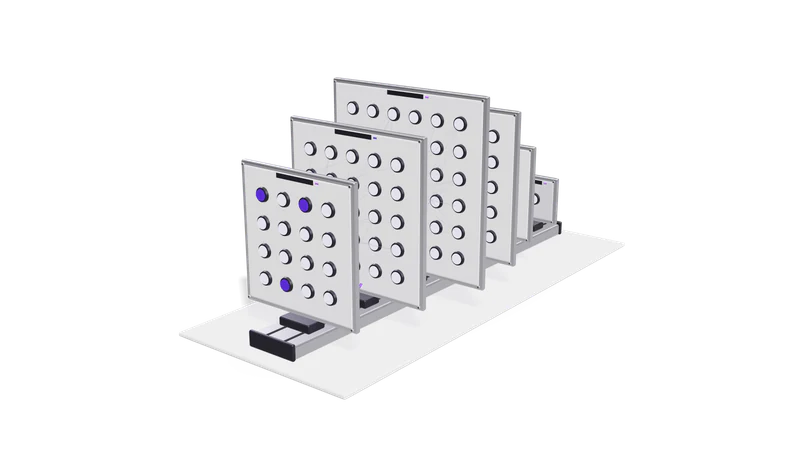
The developer publishes the weights so anyone can run them, unlike API-only models. Open-weight is not always open source: training data is usually not shared.
Every neural network is a set of weights: billions of numbers learned during training. An open-weight model is one where the developer publishes those weights, usually on Hugging Face, so anyone can load them into their own software. Examples include Meta's Llama, Alibaba's Qwen, Mistral's models, Google's Gemma, DeepSeek's models and OpenAI's gpt-oss.
The opposite is a closed or API-only model, which you can use only by sending requests to the provider's servers.
"Open-weight" is not always the same as "open source". Open source in the strict sense also means the training code and enough information about the data to rebuild the model, as set out in the Open Source Initiative's Open Source AI Definition. Most open-weight releases share the weights but not the training data.
Apache 2.0 and MIT licences allow commercial use with few conditions.
Apache 2.0 and MIT licences (used for some Mistral, Qwen, DeepSeek and gpt-oss releases) allow commercial use with few conditions.
Llama allows commercial use with conditions; Gemma has its own terms and prohibited uses.
Llama's licence allows commercial use but adds conditions, such as attribution and a separate licence for very large platforms. Gemma has its own terms of use with a prohibited use policy.
Some releases forbid commercial use entirely. Check before building on one.
Some releases forbid commercial use entirely. Check before building a product on one.
Run it on your own servers so client data never reaches an outside AI provider.
Run the model on your own servers so client data never reaches a third-party AI provider.
Fine-tune or train a LoRA adapter, which closed models allow only in limited ways.
The model you tested stays the model you run; nobody can change or retire it.
The model you tested is the model you run. A provider cannot change or retire it under you.
A company tests three open models on fifty real questions, checks licences, picks the smallest that passes, and reruns the test before any switch.
A company wants an assistant that drafts replies from its policy manuals. It tests three open-weight models of different sizes against fifty real questions with known answers, checks their licences for commercial use, picks the smallest one that passes, quantizes it to fit a single GPU, and serves it inside the office network. When a better model is released, it reruns the same fifty questions before switching.
Licences can restrict uses, require attribution or limit very large deployments.
Licences can restrict use cases, require attribution or limit very large deployments.
Use the official repository or a well-known converter; model files can be tampered with.
Use the developer's official repository or a well-known converter. Model files can be tampered with.
Benchmark scores are not your tasks. Evaluate on your own data.
Benchmark scores are not your tasks. Run a model evaluation on your own data.
The largest open-weight models are competitive on many tasks, but the models you can run on modest hardware are smaller and weaker at complex reasoning. For narrow, well defined business tasks a smaller open model is often enough. Test on your own work.
Many allow it, but licences vary. Apache 2.0 and MIT models are the simplest. Read the licence of the exact model and version before you build on it.
No. Running a downloaded model on your own hardware sends nothing back to the developer unless your software is set up to do so.
Last updated