CyberFreezeDev Loading
  1. Home
  2. AI glossary
  3. On-premise AI

What is on-premise AI?

AI that runs on hardware you control, so your data goes to your model only.

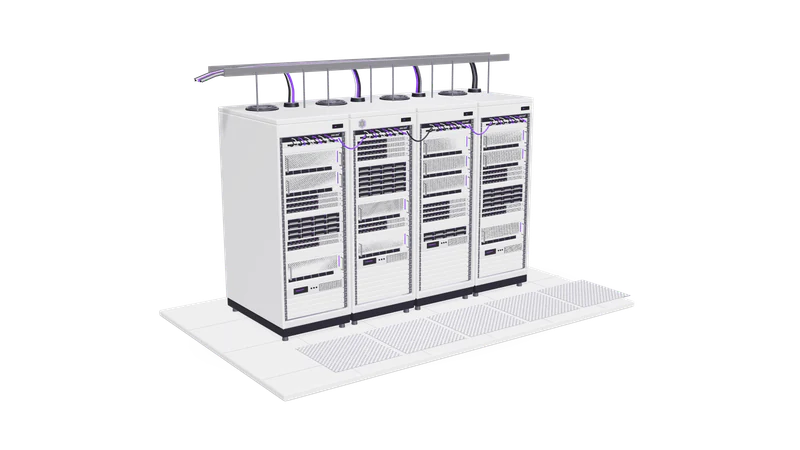
3D render of matte white server racks with violet status lights under an overhead cable tray

Definition

Model, inference server and data all live on infrastructure you control, made practical by open-weight models you can download and run.

Read more about Definition

On-premise AI (also called private AI or self-hosted AI) means the model weights, the inference server and the data all live on infrastructure you control: a GPU server in your office, a rack in a data centre, or a dedicated machine you rent where nobody else's workload runs. The opposite is calling a hosted API, where your prompt travels to the provider and is processed on their machines.

It became practical for most companies because of open-weight models such as Llama, Qwen, Mistral and Gemma, which you can download and run yourself.

How a typical setup works

  1. 01 Hardware

    One or more GPUs with enough VRAM for the model, plus storage and RAM.

    Read more about Hardware

    One or more GPUs with enough VRAM for the chosen model, plus fast storage and RAM.

  2. 02 Model

    An open-weight model, often quantized to fit the hardware.

    Read more about Model

    An open-weight model, often quantized to fit the hardware.

  3. 03 Inference server

    Software such as vLLM or Ollama loads the model and serves an API.

    Read more about Inference server

    Software such as vLLM, Ollama or llama.cpp that loads the model and exposes an API, often compatible with the OpenAI API format so existing tools work.

  4. 04 Application layer

    Chat, document search and automations, all behind your login and audit logs.

    Read more about Application layer

    Chat interfaces, retrieval-augmented generation over internal documents, and automations, all behind your login and audit logs.

Where it matters in business

Regulated and confidential data

Patient records, client books, legal files and HR data stay off outside APIs.

Read more about Regulated and confidential data

Patient records in clinics, client books at CA firms, legal files and HR data, where sending text to an outside API needs contracts and risk review.

Data residency

Processing stays in a set country or building for contracts or sector rules.

Read more about Data residency

Keeping processing in a specific country or building to meet client contracts or sector rules.

Predictable cost at volume

Steady heavy workloads can cost less on owned hardware; spiky use usually does not.

Read more about Predictable cost at volume

High, steady workloads such as document processing can cost less on owned hardware than per-token API billing. Low or spiky use usually does not.

A practical example

A CA firm runs a quantized model and document index on one office workstation, with staff sign-in, logged questions and no internet route except patches.

Read more about A practical example

A CA firm wants staff to ask questions about client agreements and past notices without uploading them to a public chatbot. A workstation with one large-memory GPU runs a quantized open-weight model through vLLM. A document index built with embeddings lives on the same machine. Staff sign in through the firm's existing accounts, every question is logged, and the server has no route to the internet except for patch updates.

Common mistakes

Expecting frontier quality from a small model

A model on one 8 GB card will not match the largest hosted models. Test first.

Read more about Expecting frontier quality from a small model

A model that fits on one 8 GB card will not match the largest hosted models on hard reasoning. Test on your real tasks before buying hardware.

Forgetting operations

Someone must patch, monitor, back up and upgrade the stack. Budget for it.

Read more about Forgetting operations

Someone must patch, monitor, back up and upgrade the stack. Budget for it.

Calling it private while logs leak

Telemetry, extensions and plugins can still send data out. Check the whole path.

Read more about Calling it private while logs leak

Telemetry, browser extensions and third-party plugins can still send data out. Check the whole path, not only the model.

Questions

Is on-premise AI more secure than a cloud API?

It removes one party from the data path, which simplifies contracts and risk reviews. It is only as secure as your own servers, access control and patching, so it moves responsibility to you rather than removing it.

What hardware do I need for a private LLM?

It depends on model size. A small quantized model runs on a single consumer GPU with 8 to 16 GB of VRAM. Larger models need data centre GPUs or several cards. Size the hardware after testing the model on your own tasks.

Can I use on-premise AI with my existing tools?

Usually yes. Inference servers such as vLLM and Ollama offer an OpenAI-compatible API, so many tools and automation platforms such as n8n can point at your server instead of a public endpoint.

Last updated