CyberFreezeDev
- Home
- Blog
- Industry guides
- Edge AI use cases in manufacturing for small factories
Edge AI use cases in manufacturing for small factories
Edge AI puts a small computer beside the camera or sensor so it counts, checks and alerts on site and sends only the result. Here are six uses that suit a small plant, the boards that run them, and what to do about camera footage.
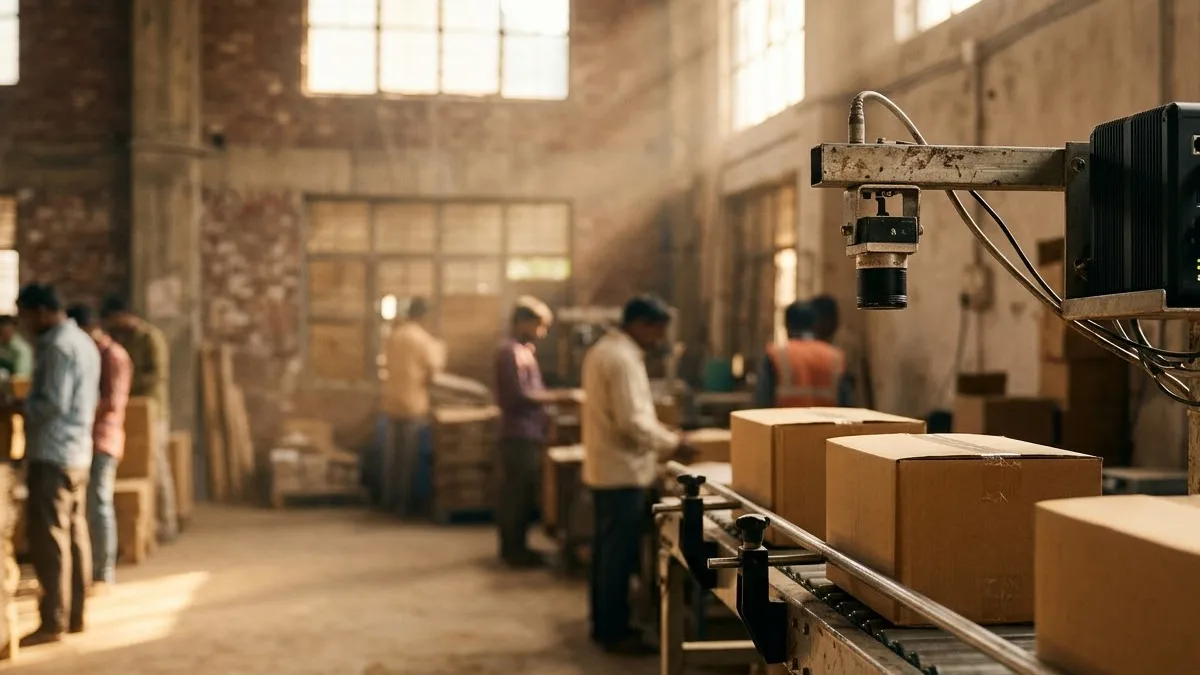
The most useful edge AI use cases in manufacturing for a small plant are counting output, checking PPE, reading old gauges, listening for machine faults and watching restricted zones. Each runs a model on a small computer beside the camera or sensor, so the decision is made on site and only a count or an alert leaves the building.
Edge AI suits plants where the internet is patchy, cameras see workers, and nobody wants a monthly cloud video bill. Here are six uses, the boards that run them, and what to do about the footage.
Which edge AI use cases suit a small plant?
| Use | Input | What the device sends |
|---|---|---|
| Counting output | Camera over a conveyor or packing table | Count per minute or per shift |
| PPE checks | Camera over a marked zone | Alert with one cropped frame when a helmet or vest is missing |
| Gauge and display reading | Camera pointed at an analogue gauge or a panel with no data port | A reading every few minutes |
| Machine sound or vibration | Microphone or vibration sensor on a motor or pump | A score, and an alert when it drifts from normal |
| People in restricted zones | Camera over the area around a press or other moving machine | Alert when a person is inside while the machine runs |
| Simple presence checks | Camera at the end of the line | Pass or fail: cap fitted, label present |
Counting. A detector finds each carton or part, a tracker follows it, and a count goes up when it crosses a line. Ultralytics documents this line and region counting in its YOLO guides. Check the licence before building on it: Ultralytics YOLO is AGPL-3.0, and its licence page says an Enterprise licence is needed to use it without open sourcing your project, including on edge devices.
PPE checks. The camera watches one marked zone, not the whole floor, and the alert goes to the supervisor's phone with the frame attached. A tight zone keeps false alarms down.
Gauge reading. Many plants have pressure and temperature gauges that nobody logs. A fixed camera and a small model turn them into a time series without rewiring the machine.
Sound and vibration. Faults are rare, so you seldom have enough recordings of them to train on. The common approach is to learn what normal sounds like and flag what does not. The public MIMII dataset, with normal and faulty recordings of valves, pumps, fans and slide rails, was built for exactly this research.
Restricted zones. This alerts a supervisor. It is not a safety system and must not replace guards, light curtains or interlocks.
What hardware does each job need?
All figures are the vendors' own ratings. TOPS are quoted at different precisions, so they are not directly comparable.
| Board | Vendor rating | Good for |
|---|---|---|
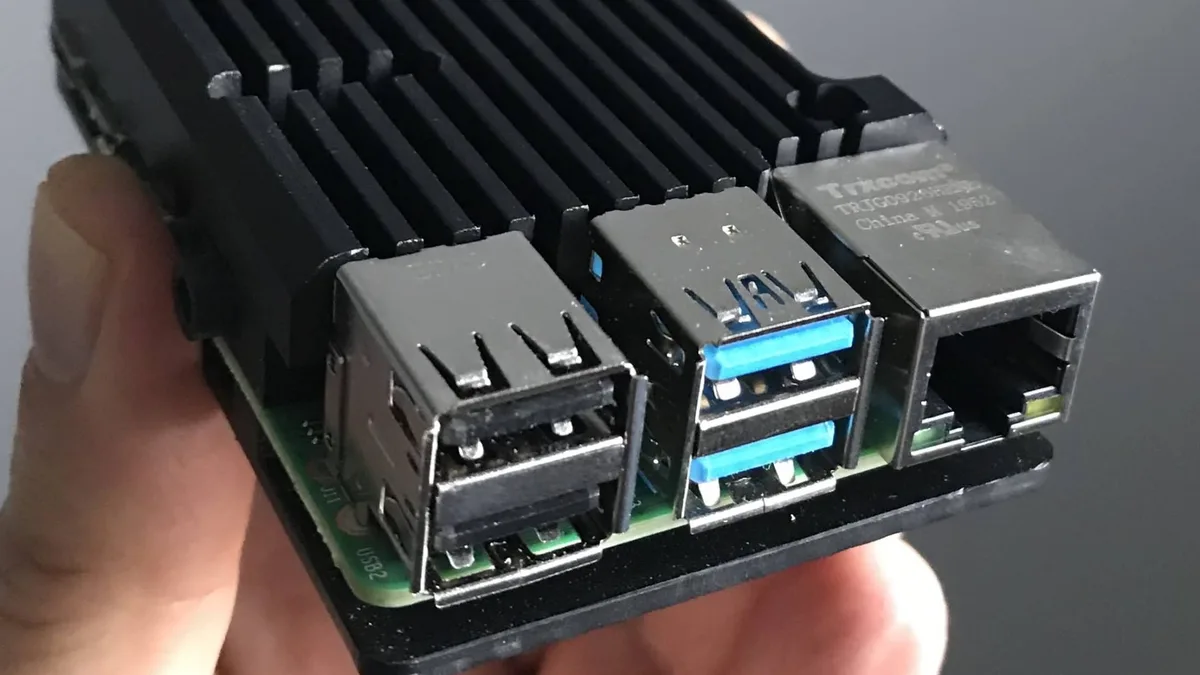
| Raspberry Pi 5 with AI HAT+ | 13 TOPS (Hailo-8L) or 26 TOPS (Hailo-8), uses the Pi's RAM | One or two cameras: counting, PPE, presence checks |
| Raspberry Pi 5 with AI HAT+ 2 | 40 TOPS at INT4 (Hailo-10H), 8 GB on the board | Small language and vision language models on site |
| Raspberry Pi AI Camera | Sony IMX500 runs the model on the sensor | One fixed view, such as a gauge or a single checkpoint |
| Google Coral Edge TPU | 4 TOPS, 2 TOPS per watt | Adding a fast classifier to an existing Linux box |
| NVIDIA Jetson Orin Nano Super | 67 INT8 TOPS, 8 GB LPDDR5, 7 to 25 W | Several camera streams, custom PyTorch models |
Sound and vibration models are small and often run on the Pi's own processor. The real choice is between a Pi with an accelerator and a Jetson, and it turns on whether your model compiles for the Pi's accelerator. Our Jetson vs Raspberry Pi comparison goes through that decision.
What should happen to the camera footage?
Cameras on a shop floor film workers. The safest design is the one edge AI makes easy: process frames on the device, keep no continuous recording, and send only counts and alerts. Where a frame is needed as evidence, store that one crop, for a set number of days.
What the rules say, in short:
- UK. The ICO's guidance on monitoring workers says that for video or audio monitoring you should complete a data protection impact assessment and tell workers the extent and nature of the monitoring and why. The ICO notes the guidance is under review after the Data (Use and Access) Act.
- India. The DPDP Act 2023 defines personal data as any data about an individual who is identifiable by or in relation to it, and applies to such data in digital form. A clear recording of a worker is likely to count.
This is general information, not legal advice. Put up notices, tell staff what the camera does and does not do, and keep the footage on the plant network.
How should a small plant start?
- Pick one job a person does by eye today. Counting dispatch boxes, walking to read a gauge, checking helmets at one door.
- Fit one camera or sensor and record for two weeks across shifts, with the lights as they really are.
- Measure against the manual figure. If the device's count and the supervisor's count disagree, find out why before adding a second camera.
- Plan for the network dropping. The device should keep its results and send them when the link returns.
- Decide who looks after it. A board that nobody updates is a weak spot on your network.
Our engineers work hands on with Jetson, Raspberry Pi and Coral boards and IoT sensors in our edge AI development work. Our manufacturing page shows how this connects to purchase, dispatch and the accounts office.
If there is one count, one gauge or one machine on your floor you would like watched without a person walking to it, tell us about it and we will say which board and sensor fit. Book a consultation.