CyberFreezeDev Loading
  1. Home
  2. AI glossary
  3. Edge AI

What is edge AI?

Running AI models on devices near the data, like a camera board or phone.

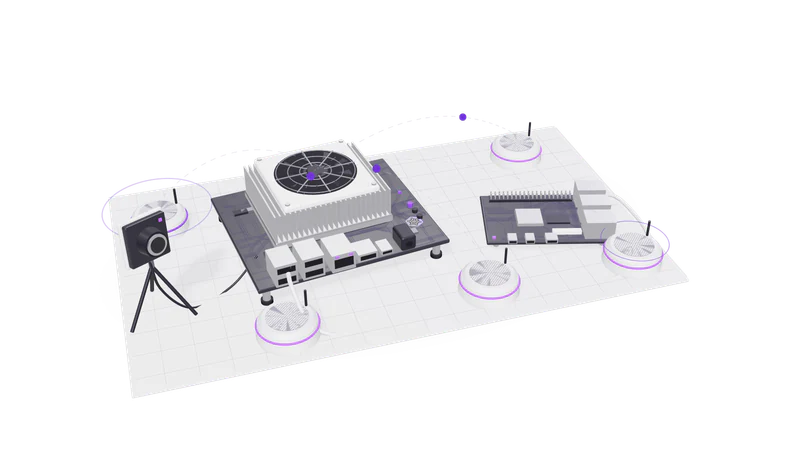
3D render of an AI developer kit, a single board computer, a camera module and IoT sensor pucks

Definition

The device runs the model on raw data locally and sends only the result onward. Training usually still happens on bigger GPU machines.

Read more about Definition

Edge AI is running AI inference on hardware at the "edge" of a network, close to sensors and users, rather than in a central data centre. The device receives raw data (video frames, vibration readings, audio), runs a model locally, and sends only the result onward: "defect at 14:02", "door open", "temperature trend abnormal".

Training usually still happens on bigger GPU machines. The edge device runs a smaller, often quantized copy of the trained model.

Typical hardware

NVIDIA Jetson

Small modules with an onboard GPU, suited to several cameras and heavier vision models.

Read more about NVIDIA Jetson

Small modules with an onboard GPU and CUDA support. Good for several camera streams and heavier vision models. See NVIDIA Jetson.

Raspberry Pi

A cheap Linux board for light models, sensor hubs and gateways.

Read more about Raspberry Pi

A cheap Linux board for light models, sensor hubs and gateways. Pairs with add-on accelerators for faster inference.

Google Coral

An Edge TPU accelerator for TensorFlow Lite models, as USB sticks or modules.

Read more about Google Coral

An Edge TPU accelerator for TensorFlow Lite models, available as USB sticks and modules. See Coral.

Microcontrollers

Tiny chips running very small models, such as keyword spotting, on battery power.

Read more about Microcontrollers

Tiny chips that run very small models for keyword spotting or anomaly detection on battery power.

Why businesses choose it

Latency

A reject arm on a conveyor cannot wait for a cloud round trip.

Read more about Latency

A reject arm on a conveyor cannot wait for a round trip to a cloud region.

Bandwidth

Sending results instead of video saves upload costs, especially on 4G at remote sites.

Read more about Bandwidth

Sending results instead of continuous video saves upload costs, especially on 4G links at remote sites.

Privacy

Frames with faces are processed and discarded on the device, which helps with data law.

Read more about Privacy

Frames with faces can be processed and discarded on the device, which helps with the DPDP Act 2023 and UK GDPR.

Keeps working offline

Local decisions continue on patchy internet, and results sync when the link returns.

Read more about Keeps working offline

A site with patchy internet still gets local decisions, and results sync when the link returns.

A practical example

A Jetson board watches freezer doors and aisles in a cold store and triggers a WhatsApp alert, with no video leaving the building.

Read more about A practical example

A cold storage warehouse wants an alert when a freezer door stays open or a pallet blocks an aisle. A Jetson board reads two camera feeds and runs a computer vision model locally. Temperature sensors report to the same board. When a rule fires, the board posts a small JSON message to a webhook, which triggers a WhatsApp alert to the shift lead. No video leaves the building.

Common mistakes

Choosing hardware before the model

Test the model first, then size the device. Cloud-sized models may not fit.

Read more about Choosing hardware before the model

Pick and test the model first, then size the device. A model that fits in a cloud GPU may not fit in 4 or 8 GB of shared memory.

No remote update plan

Field devices need new models, logs and security patches without a site visit.

Read more about No remote update plan

Devices in the field need a way to receive new model versions, logs and security patches without a site visit.

Ignoring heat and power

Hot factory enclosures throttle or fail. Plan cooling and a stable power supply.

Read more about Ignoring heat and power

Small enclosures in hot factories throttle or fail. Plan for cooling and a stable power supply.

Questions

Is edge AI the same as on-premise AI?

They overlap but differ in scale. On-premise AI usually means servers in your office or data centre running large models. Edge AI means small devices spread out next to sensors and cameras, each running a compact model.

Can a large language model run on an edge device?

Small language models can, after quantization, on boards with enough memory such as higher-end Jetson modules. Large models with tens of billions of parameters need server GPUs.

How do edge devices get model updates?

Through a device management setup: devices check a central server for new model files and configuration, download them, verify them and switch over, with a way to roll back if the new version misbehaves.

Last updated