CyberFreezeDev Loading
  1. Home
  2. Comparisons
  3. Jetson vs Raspberry Pi for edge AI

Jetson vs Raspberry Pi for edge AI projects

Jetson brings an NVIDIA GPU; Raspberry Pi brings a low-cost board with add-on accelerators.

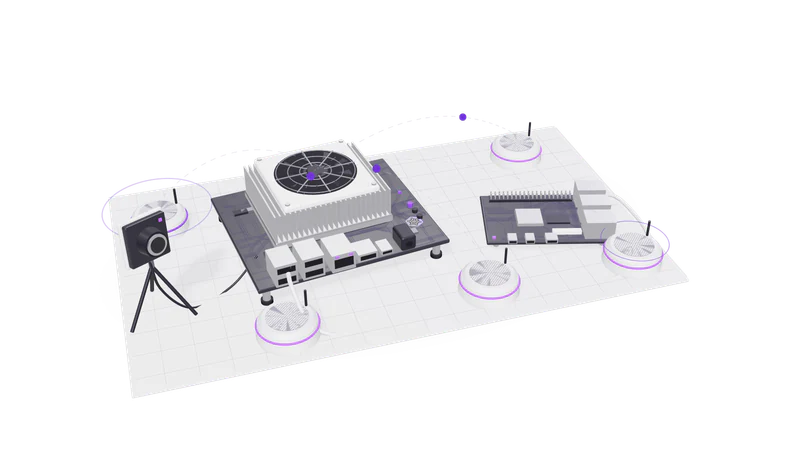
3D render of an AI developer kit, a single board computer, a camera module and IoT sensor pucks

The short answer

Jetson suits heavy, custom or multi-stream models. Raspberry Pi suits lighter jobs and large fleets, if your model fits its accelerator toolchain.

Read more about The short answer

Choose NVIDIA Jetson when the model is heavy or unusual: several camera streams, a custom PyTorch model, segmentation, or a small language model on the device. CUDA and TensorRT mean most models trained on a desktop GPU can be brought across with less conversion work.

Choose Raspberry Pi when the job is lighter or the fleet is large: one camera doing object detection, sensor readings with a small model, a kiosk, a counter. A Pi 5 with an AI HAT+ runs common vision models well at a lower cost per device and with a huge community behind it.

In the Jetson vs Raspberry Pi comparison, the real question is whether your model fits the Pi's accelerator toolchain. If it does, the Pi is usually cheaper to deploy at scale. If it does not, Jetson saves weeks of engineering. Our engineers work hands-on with Jetson, Raspberry Pi and Coral boards through our edge AI and on-device AI service.

Side by side

Comparing the two entry boards most edge projects start with. Specifications from the vendors' pages on 13 October 2026.

Compared onJetson Orin Nano Super Developer KitRaspberry Pi 5 with AI HAT+ or AI HAT+ 2
AI computeAmpere GPU with 1,024 CUDA cores; NVIDIA rates it at 67 INT8 TOPSHailo accelerator: 13 or 26 TOPS INT8 (AI HAT+), 40 TOPS INT4 (AI HAT+ 2)
CPU6-core Arm Cortex-A78AE4-core Arm Cortex-A76
Memory for models8 GB LPDDR5 shared by CPU and GPUPi system RAM; AI HAT+ 2 adds 8 GB on the accelerator
PowerConfigurable modes from 7 W to 25 WLower for the board itself; the HAT adds its own draw
SoftwareJetPack: CUDA, cuDNN, TensorRT, DeepStream; PyTorch runs nativelyRaspberry Pi OS; models compiled to Hailo's format, with a model zoo of ready networks
Model flexibilityHigh: most PyTorch and ONNX models run, often after TensorRT optimisationGood for supported architectures; unusual layers may not compile
Language models on deviceSmall LLMs and vision-language models run on the GPUAI HAT+ 2 is designed for small LLMs and vision-language models
Community and accessoriesStrong developer community, fewer cheap accessoriesVery large community, cases, cameras and HATs everywhere
Production pathJetson modules on a commercial or custom carrier boardCompute Module 5 on a carrier board, or the Pi 5 itself

Sources: Jetson Orin Nano Super Developer Kit, Raspberry Pi AI HAT+ documentation. TOPS figures are vendor ratings at different precisions and are not directly comparable.

Where each one wins

Jetson wins on model freedom

Custom PyTorch models run with CUDA, without first compiling to an accelerator's format.

Read more about Jetson wins on model freedom

If your team trained a custom detector or segmentation model in PyTorch, Jetson runs it with CUDA, and TensorRT can optimise it further. On a Pi with a Hailo accelerator the model must compile to Hailo's format first, which works smoothly for common architectures and can stall on unusual ones.
Jetson wins on multiple streams

Hardware video decoding and DeepStream handle several camera streams at once.

Read more about Jetson wins on multiple streams

Watching four entry cameras at a warehouse, or a line camera plus a thermal camera on a machine, needs hardware video decoding and GPU throughput. DeepStream is built for exactly this kind of multi-stream video pipeline.

Raspberry Pi wins on cost per device

Cheaper boards and accessories add up across fifty units, and swaps are easy.

Read more about Raspberry Pi wins on cost per device

When a project needs fifty units, one per shop counter or per machine, the lower board price, cheaper accessories and easy replacement add up. A failed Pi can be swapped by someone on site.

Raspberry Pi wins on simplicity

A well-documented OS, camera stack and GPIO keep the focus on the problem.

Read more about Raspberry Pi wins on simplicity

Raspberry Pi OS, the camera stack and GPIO are documented to a level few boards match. For sensor projects where the AI part is a small classifier, the Pi lets you spend time on the problem rather than the platform.

Neither wins every time

Coral, the Pi AI Camera or a private server may suit very light models better.

Read more about Neither wins every time

For very light models a Coral USB accelerator on an existing computer, or the Raspberry Pi AI Camera that runs a model on the sensor itself, can be enough. We also consider whether the job needs edge hardware at all, or can send frames to a private server.

How the costs are structured

Board prices move with exchange rates, import duty and supply, so we describe the cost shape and point you to the vendors for current prices.

The board price is the obvious cost, but engineering is usually larger. Plan accessories, import duty and remote updates for every unit from the start.

Read more about How the costs are structured

Per-device hardware is the obvious cost. A Jetson developer kit costs several times a Raspberry Pi 5 board, and the Pi's AI HAT+ or AI HAT+ 2 narrows that gap but does not close it. Add a camera, storage (an NVMe SSD is worth it on both), power supply, enclosure and mounting, which often cost as much as the board in an industrial setting. In India, add import duty and distributor margins, and check stock lead times before committing to a schedule.

Engineering is the larger cost on most projects. Converting and tuning a model for the target accelerator, building the capture pipeline, handling network drops and updating devices in the field take more time than buying hardware. Jetson tends to cost less engineering for custom models; the Pi tends to cost less for standard ones.

Running costs include power (small on both, but it matters on battery or solar), remote management and software updates for every unit, and replacements. A plan for updating fifty devices without visiting them belongs in the first design, not the last.

How we pick a board for a project

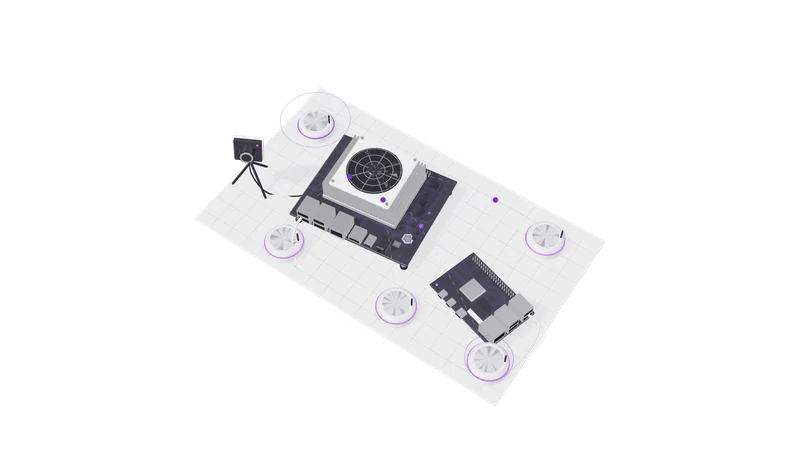
Fig. 01 Overhead: dev kit, board, camera module and sensor pucks
  1. 01 Fix the model first

    The candidate model is tested on real images or sensor data from your site.

    Read more about Fix the model first

    We test the candidate model on the actual task with real images or sensor data from your site. The board decision follows from what the model needs.

  2. 02 Check the toolchain

    We confirm the model compiles and runs well on the Pi's accelerator.

    Read more about Check the toolchain

    We confirm the model compiles and runs on the Pi's accelerator. If it does not, or loses too much accuracy, Jetson moves ahead.

  3. 03 Measure on the hardware

    Frame rate, latency, power and temperature recorded on the real board and camera.

    Read more about Measure on the hardware

    We run it on the board with the real camera and record frame rate, latency, power and temperature. We publish only benchmarks we actually ran, with method, hardware, versions and date.

  4. 04 Price the fleet

    Full unit cost times sites, plus the update and support plan.

    Read more about Price the fleet

    We cost the full unit including enclosure and mounting, multiply by the number of sites, and add the update and support plan.

What we recommend and why

Pi 5 with an AI HAT+ for standard single-camera jobs at scale, Jetson for multi-camera or custom models, and a server when no edge device is needed.

Read more about What we recommend and why

We recommend Raspberry Pi 5 with an AI HAT+ for single-camera detection, counting, presence and sensor classification projects using standard model architectures, especially when many units are needed. It is cheaper to deploy and easier for local staff to maintain.

We recommend Jetson for multi-camera video, custom or heavier models, and on-device language or vision-language models where the Pi's accelerator would limit the choice of model. It costs more per unit and saves engineering time where models are not standard.

We tell clients plainly when a cloud or on-premise server is a better fit than any edge device, for example when the cameras are on a reliable network and nothing needs to react within milliseconds. Our edge AI and IoT lab track is where we test this hardware, and the edge AI glossary entry covers the basics.

Questions

Can a Raspberry Pi run AI without an accelerator?

Yes, for small models. The Pi 5's CPU runs light classifiers and small detectors at modest frame rates. For real-time video or larger models, an AI HAT+ or the AI Camera makes a large difference.

Can these boards run a language model?

Small ones. Jetson runs small LLMs and vision-language models on its GPU within its 8 GB of shared memory. The Raspberry Pi AI HAT+ 2 adds 8 GB on the accelerator and is designed for small LLMs and vision-language models. Large models still need a GPU server.

Which is better for a factory or outdoor site?

Neither developer kit is built for harsh environments as sold. For production we put the module (a Jetson module or a Raspberry Pi Compute Module 5) on a carrier board in a suitable enclosure, with attention to heat, dust and power.

Do you also work with Google Coral?

Yes. Coral's Edge TPU is a low-power option for TensorFlow Lite models and can be added to an existing machine over USB. It suits narrow, light models rather than general-purpose work.

Last updated