CyberFreezeDev Loading
  1. Home
  2. Comparisons
  3. n8n vs Zapier

n8n vs Zapier: which automation platform fits your business

Two app-connecting tools that differ on billing, where data runs and who maintains them.

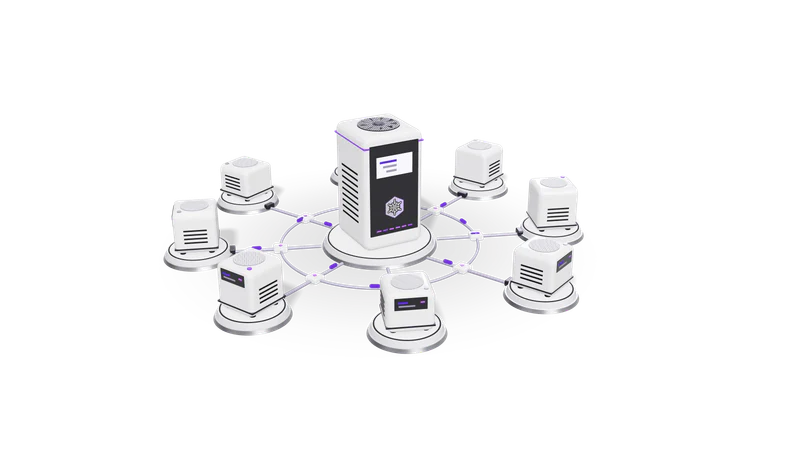
3D render of small AI agent units on plinths, cabled to a central orchestrator unit

The short answer

Zapier suits a few simple automations with no server to run. n8n suits long, frequent or sensitive workflows that need code and AI steps.

Read more about The short answer

Choose Zapier when a small team needs a handful of simple automations running this week, nobody wants to look after a server, and the apps you use are mainstream SaaS tools. Choose n8n when workflows have many steps, run thousands of times a month, touch customer or financial data you would rather keep on your own server, or need custom code and AI steps in the middle.

In the n8n vs Zapier decision, most of the cost and control questions come down to two facts. Zapier counts every successful action step as a task. n8n Cloud counts a whole workflow run as one execution, and the self-hosted Community Edition has no per-run fee at all. We build on n8n through our n8n integrations and AI workflow automation work, and we leave a working Zap alone when it is doing its job.

Side by side

Checked against each vendor's public pricing and documentation on 13 October 2026.

Compared onn8nZapier
How it is hostedn8n Cloud, or self-hosted on your own server or VPS (Community Edition, Business and Enterprise)Zapier's cloud only
Billing unitHosted plans: workflow executions, where one full run counts once however many steps it hasTasks: each successful action step counts; triggers, filters and Formatter steps do not
Free optionCommunity Edition, self-hosted under the Sustainable Use License; you pay only for the serverFree plan with a small monthly task allowance and two-step Zaps only
App catalogueHundreds of built-in nodes plus an HTTP Request node for any REST APIOver 9,000 listed apps, the larger catalogue by a wide margin
Custom logicCode nodes in JavaScript and Python, loops, merges, sub-workflows, error workflowsPaths, filters, Formatter and Code by Zapier with runtime limits
AI stepsAI Agent and LLM nodes; you bring your own model keys, including local modelsAI actions, Zapier Agents and Copilot; AI steps count as tasks
Who can buildComfortable for a technical operator or developerComfortable for a non-technical operations person
Data locationWherever you host it, including a server in IndiaZapier's infrastructure
MaintenanceYou (or we) handle updates, backups and monitoring when self-hostedZapier handles it

Sources: n8n pricing, Zapier pricing, n8n Sustainable Use License. Plans and allowances change, so check the vendor pages before you commit.

Where each one wins

Neither tool is better in general. Each wins in specific situations.

Zapier wins on breadth and zero upkeep

A niche app with a Zapier integration, and no server to patch, back up or watch.

Read more about Zapier wins on breadth and zero upkeep

If a niche SaaS tool your team depends on has a Zapier app and no n8n node, Zapier gets you running without writing an API call. There is no server to patch, no backup to test and no queue to watch. For an office manager who wants new Typeform entries in a Google Sheet and a Slack ping, Zapier is the faster and kinder choice.

n8n wins on volume and step count

A ten-step workflow can use ten Zapier tasks per run, but only one n8n execution.

Read more about n8n wins on volume and step count

A ten-step workflow that runs 1,000 times a month can use up to 10,000 Zapier tasks. The same workflow is 1,000 executions on n8n Cloud and costs nothing per run when self-hosted. The more steps and runs you have, the wider that gap gets.

n8n wins on data control

Invoices, patient enquiries and KYC documents pass only through infrastructure you control.

Read more about n8n wins on data control

Self-hosted n8n runs on a server you choose, so invoices, patient enquiries or KYC documents pass through infrastructure you control. For Indian businesses thinking about the DPDP Act 2023, and UK clients working under UK GDPR, that is often easier to explain to a client or auditor.

n8n wins on custom logic

JavaScript or Python inside the workflow, plus error workflows that alert someone.

Read more about n8n wins on custom logic

Real business processes need loops over line items, retries, merges of two data sources and the odd regular expression. n8n lets an engineer drop into JavaScript or Python inside the workflow and wire an error workflow that alerts someone when a run fails.

Zapier wins when nobody technical will own it

With no developer or support contract, a managed service is safer than an unmaintained server.

Read more about Zapier wins when nobody technical will own it

A self-hosted n8n instance that nobody updates becomes a liability. If there is no developer and no support contract, Zapier's managed service is the safer place for business-critical automations.

How the costs are structured

We describe the pricing models, not the price points, because the numbers change. Check the linked pages for current figures.

Zapier cost scales with steps times runs, n8n Cloud with runs only, and self-hosted n8n with the server and upkeep. Both need someone maintaining the workflows.

Read more about How the costs are structured

Zapier sells a plan level (Free, Professional, Team, Enterprise) combined with a monthly task tier. A task is one successful action; triggers and failed steps are not counted, and built-in tools such as Filter and Formatter are not counted either, according to Zapier's pricing page. If you go over your tier and pay-per-task is on, extra tasks are billed at a higher rate than the base allowance. The practical effect: cost scales with steps times runs.

n8n Cloud sells plans (Starter, Pro and Enterprise) with a monthly execution allowance (Business is a self-hosted paid edition), and every plan includes unlimited users and workflows, per n8n's pricing page. Cost scales with runs only. A workflow with 3 steps and one with 30 steps cost the same per run.

Self-hosted n8n Community Edition has no licence fee for internal business use. Your costs are a Linux server (a small VPS handles most small business loads), a database backup, and someone's time for updates and monitoring. At higher volume n8n supports queue mode with Redis and separate worker processes, which is more infrastructure to run. Features such as SSO, environments and log streaming sit in the paid Business and Enterprise editions.

The hidden cost on both sides is maintenance of the workflows themselves: an API changes, a Google Sheet column gets renamed, a token expires. Budget for someone to own that, whichever tool you pick.

How we decide for a client

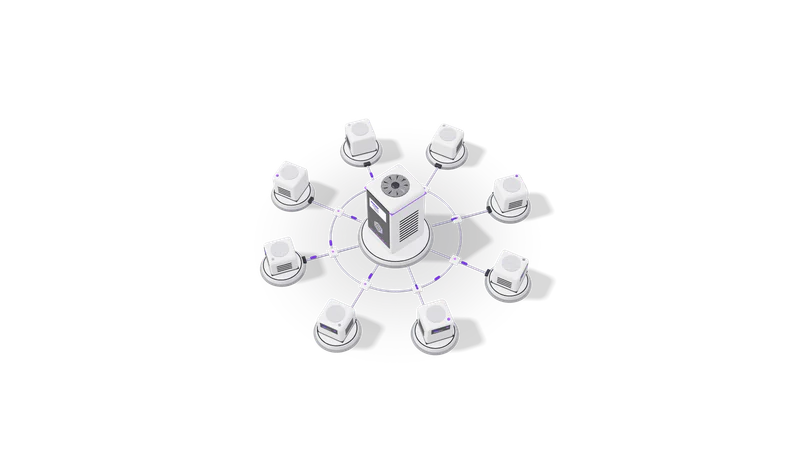
Fig. 01 High angle: each agent unit cabled to the orchestrator
  1. 01 List the workflows and count the steps

    Each automation's trigger, steps and frequency give real task and execution estimates.

    Read more about List the workflows and count the steps

    We write down each automation, its trigger, its steps and how often it runs. This gives a monthly task estimate for Zapier and an execution estimate for n8n from real numbers, not guesses.

  2. 02 Mark the sensitive data

    Personal, bank, GST or health data gets flagged, which moves self-hosted n8n up the list.

    Read more about Mark the sensitive data

    Anything carrying personal data, bank lines, GST invoices or health information gets flagged. If most workflows carry it, self-hosted n8n moves up the list.

  3. 03 Check every app has a connector

    API and webhook support checked first for Indian tools such as Tally and Razorpay.

    Read more about Check every app has a connector

    For Indian tools such as Tally or Razorpay we check the API and webhook support first. Where neither platform has a ready node, n8n's HTTP Request node is usually simpler to work with than a custom Zapier app.

  4. 04 Name the owner

    A developer or retainer points to n8n; simple workflows with no owner point to Zapier.

    Read more about Name the owner

    If the client has a developer or takes a support retainer, we usually recommend n8n. If not, and the workflows are simple, we recommend Zapier and say so plainly.

What we recommend and why

Our default is self-hosted n8n in the client's data region, since our workflows are long. Working Zaps stay; expensive or sensitive ones move.

Read more about What we recommend and why

For most of the businesses we work with, our default is self-hosted n8n on a server in the region where the client's data should live. The workflows we build tend to be long: a WhatsApp lead comes in, gets qualified by a language model, is written to a CRM, is routed to a sales rep and gets a follow-up scheduled. One anonymous client build of exactly that shape used n8n, the WhatsApp Business API, a CRM and Claude. On Zapier, every one of those steps would be a billable task on every lead.

We recommend Zapier when the team is small, the automations are short, nobody technical will own a server, and a specific app they need only exists there. We also keep Zapier in place for existing Zaps that work, and move only the expensive or sensitive ones to n8n.

If you are deciding between n8n and Make instead, read n8n vs Make, or see all three in n8n vs Zapier vs Make. If the workflow also needs to answer customers on WhatsApp, see our WhatsApp CRM.

Questions

Is n8n really free?

The self-hosted Community Edition has no licence fee for use inside your own business, under n8n's Sustainable Use License. It is fair-code rather than open source: you cannot resell n8n itself as a hosted service. You still pay for the server and for whoever maintains it.

Can we move our Zaps to n8n?

Yes, but expect to rebuild each Zap as an n8n workflow rather than import it. We usually migrate the highest-volume or most sensitive Zaps first and leave cheap, simple ones on Zapier until there is a reason to move them.

Which is easier for a non-technical team?

Zapier. Its editor walks you through each step and hides most of the data structure. n8n shows you the JSON flowing between nodes, which is powerful for an engineer and confusing for someone who has never seen JSON.

Can either one connect to Tally or Razorpay?

Both can reach any service with an HTTP API or webhooks. We build integrations with Tally and Razorpay, and on n8n we typically use the HTTP Request and Webhook nodes with proper error handling and retries.

Who looks after a self-hosted n8n server?

Either your own developer or us on a support arrangement. The job is applying n8n updates, checking backups, watching failed executions and renewing credentials. It is small but it must have an owner.

Last updated