Manufacturing
Inspection on the line for scratches, missing parts, wrong labels or fill levels.
Read more about Manufacturing
Visual inspection for scratches, missing parts, wrong labels or fill levels on a conveyor.
 CyberFreezeDev
Loading
CyberFreezeDev
Loading
Turning images and video into structured answers about what the camera sees.
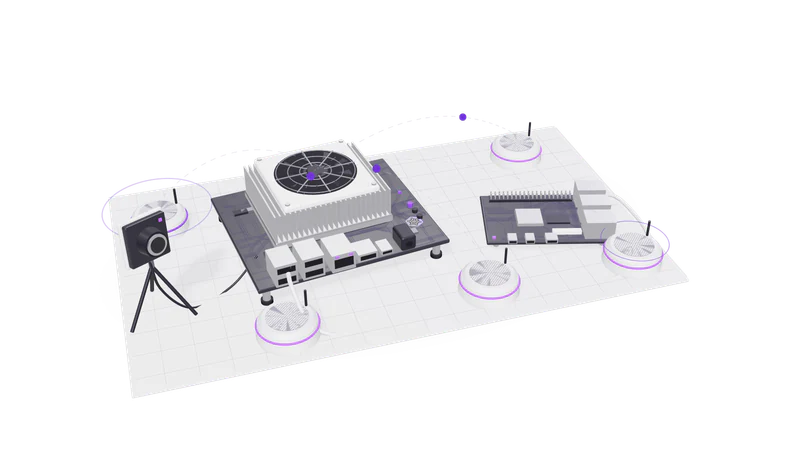
A vision model turns a grid of pixels into labels, boxes, outlines, counts or measurements that other software can act on.
Computer vision is the part of AI concerned with getting useful information out of images and video. A camera gives you a grid of coloured pixels. A computer vision model turns that grid into labels, boxes, outlines, counts or measurements that other software can act on.
Most business uses fall into a few task types:
Neural networks learn from labelled images, then run on each frame, on a server GPU or a small edge device beside the camera.
Modern computer vision uses neural networks trained on labelled images. During training the model sees thousands of examples ("this box is a helmet, this one is a bare head") and adjusts its weights until its predictions match the labels. Popular families include convolutional networks such as the YOLO detectors and vision transformers. Libraries such as OpenCV handle the plumbing: reading camera streams, resizing, cropping and drawing results.
At run time the model does inference on each frame. On a server that usually means a GPU; on a shop floor it often means a small edge AI device next to the camera, so video never has to leave the building.
Inspection on the line for scratches, missing parts, wrong labels or fill levels.
Visual inspection for scratches, missing parts, wrong labels or fill levels on a conveyor.
Shelf gaps, footfall, carton counts at dispatch and damaged parcel checks.
Shelf gap detection, footfall counts, carton counting at dispatch, damaged parcel checks.
Flags regions of interest in images for clinicians, who make the final call.
Assisting clinicians by flagging regions of interest in images. Final calls stay with a qualified person.
Finds stamps, signatures and tables before text is extracted from a document.
Finding stamps, signatures and tables before text extraction in intelligent document processing.
A camera and a small edge model catch boxes with no batch code, trigger a reject arm and log a photo for weekly review.
A packaging unit wants to stop boxes leaving without a printed batch code. A camera above the line captures each box. A small detection model, trained on a few hundred photos of boxes with and without codes, runs on an edge device beside the conveyor. When a box has no code, the device sends a signal to a reject arm and logs a photo. A supervisor reviews the logged photos weekly, and false rejects become new training images.
Light, glare, dust and angle matter more than the model. Train on real camera images.
Lighting, glare, dust and camera angle change results more than model choice. Collect training images from the real camera position.
Decide in advance what happens when the model is unsure, such as asking a person.
Decide in advance what happens when the model is unsure: route the frame to a person, as described in human in the loop.
Footage of people is personal data. Blur faces, or keep only counts.
Cameras that capture people create personal data under India's DPDP Act 2023 and UK GDPR. Blur faces or avoid storing frames when you only need counts.
It depends on how varied the scene is. A narrow task with one camera angle can start with a few hundred labelled images by fine-tuning a pretrained model. Varied scenes need more. Start small, measure errors on real footage, then add images where the model fails.
Yes. Many detection models run on devices such as NVIDIA Jetson boards or a Raspberry Pi with a Coral accelerator, so frames are processed beside the camera and only results are sent onward.
OCR is one application of computer vision: it detects and reads characters. Computer vision also covers objects, people, defects and movement.
Last updated