VRAM
The GPU's own memory. The model must fit, and it is often the first limit.
Read more about VRAM
The GPU's own memory. The model weights and working data must fit in it. See VRAM; it is often the first limit you hit.
 CyberFreezeDev
Loading
CyberFreezeDev
Loading
A graphics chip that does thousands of small calculations at once, which neural networks need.
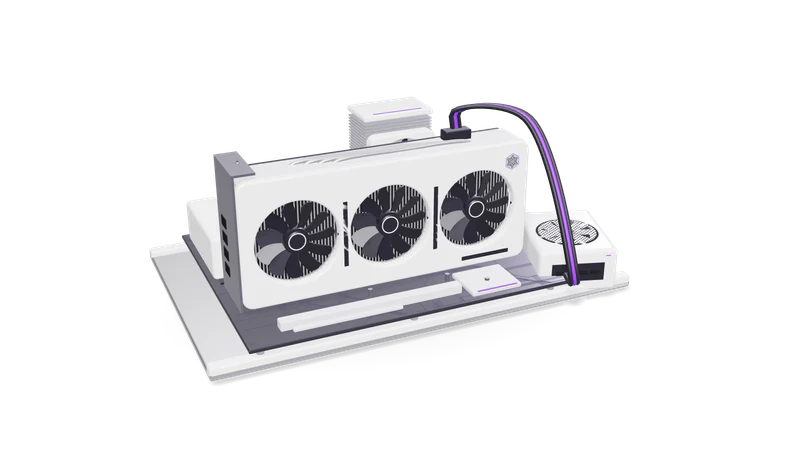
A CPU has a few strong cores; a GPU has thousands of simple ones. Neural networks are mostly matrix maths, which suits GPUs well.
A GPU (graphics processing unit) is a chip designed for massively parallel work. A CPU has a handful of powerful cores tuned for varied tasks one after another. A GPU has thousands of simpler cores that apply the same operation to large blocks of numbers at once.
A neural network is mostly matrix multiplication: inputs times weights, layer after layer. That maps directly onto a GPU, which is why training and inference for anything beyond small models runs on GPUs or similar accelerators.
The GPU's own memory. The model must fit, and it is often the first limit.
The GPU's own memory. The model weights and working data must fit in it. See VRAM; it is often the first limit you hit.
How fast the GPU reads its memory, often the real limit on LLM text speed.
How fast the GPU can read its memory. For LLM text generation this often limits speed more than raw compute.
Special cores for fast low-precision maths, which quantized models use.
Recent NVIDIA GPUs have tensor cores for fast low-precision maths (FP16, BF16, INT8, FP8 on newer parts), which quantized models use.
Most AI frameworks target NVIDIA CUDA first; AMD ROCm and Apple Metal are catching up.
NVIDIA's CUDA platform is what most AI frameworks target first. AMD's ROCm and Apple's Metal work for a growing set of tools.
Running an open-weight model on your own server needs a GPU sized to it.
Running an open-weight model on your own server needs at least one GPU sized to the model.
Diffusion models are compute heavy; a GPU turns minutes into seconds per image.
Diffusion models are compute heavy; a GPU turns minutes into seconds per image.
Camera analytics on edge boards like Jetson use a small built-in GPU.
Camera analytics on edge boards such as NVIDIA Jetson use a small integrated GPU.
Our 8 GB laptop GPU runs quantized 7 to 8 billion parameter models and image work, but not 70 billion ones, and it throttles under long jobs.
Our lab machine includes an RTX 3070 Ti laptop GPU with 8 GB of VRAM. That is enough to run quantized language models in the 7 to 8 billion parameter range and to upscale or generate images, but not to load a 70 billion parameter model. Under long batch jobs a laptop GPU also heats up and the driver lowers its clock speed to protect itself, so sustained throughput is lower than the spec sheet suggests. Server cards are built for continuous load.
A fast card with too little VRAM cannot load the model. Check memory first.
A fast card with too little VRAM cannot load the model at all. Check memory first.
Multi-GPU servers need airflow and electrical capacity, or throttling quietly cuts speed.
Multi-GPU servers need proper airflow and electrical capacity. Throttling quietly cuts performance.
Rent a cloud GPU for a week with your real workload, then decide.
Rent a cloud GPU for a week, run your real workload, then decide whether to buy.
Small models can run on a CPU, and tools such as llama.cpp make that practical for light use. It is much slower, so for anything interactive or high-volume a GPU or another accelerator is the normal choice.
For development, testing and small internal tools, often yes. For continuous production load, data centre cards offer more VRAM, better cooling, error-correcting memory and licensing suited to servers.
Not always, but most AI software supports NVIDIA's CUDA first, so it is the lowest-friction option. Check that every tool in your stack supports the alternative before choosing AMD or another vendor.
Last updated